

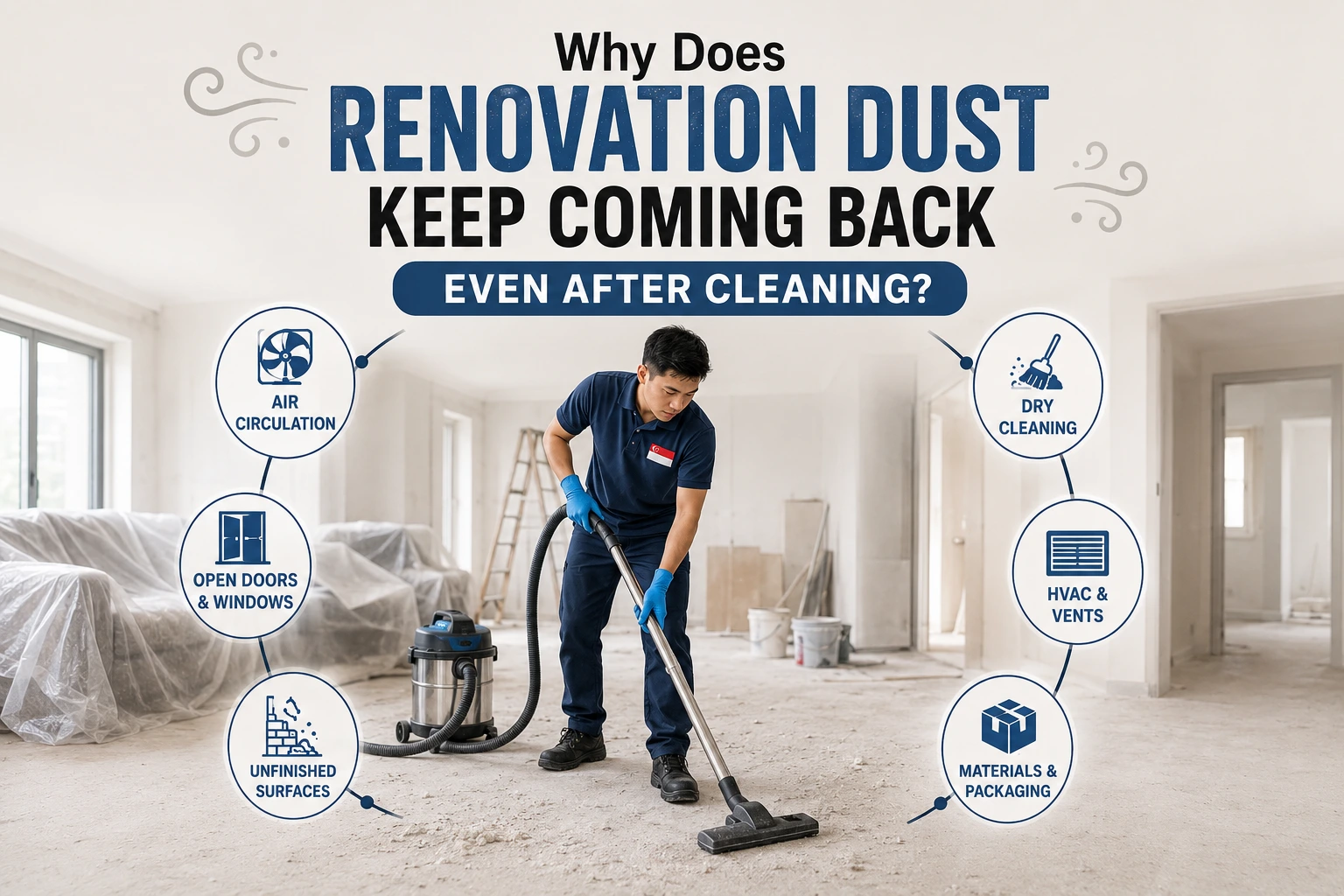
The process of finishing a home renovation brings joy to homeowners, yet the accumulation of dust after construction work leads to their growing frustration. Homeowners tend to see a thin layer of dust that reappears after they perform deep home cleaning or after professional cleaners finish their post-renovation work. This leaves many wondering whether they have chosen the best post renovation cleaning in Singapore or if the cleaning was thorough enough.
People begin to doubt the cleaning process when they discover traces of dust that continue to exist. The way renovation dust spreads through the air differs from how regular household dust particles move in the environment. The air contains small particles which come from cement, plaster, and concrete, and wood materials, until they finally touch down on surfaces after several days.
The air will absorb these particles when the building’s air conditioning system operates and when people walk through the area and perform their daily activities.
This guide explains why renovation dust keeps coming back, how long it typically lasts, where it collects, and the most effective ways to remove it for good.
What Makes Renovation Dust Different from Regular Household Dust?
Unlike everyday household dust, renovation dust is made up of microscopic particles generated from construction materials such as:
- Silica from concrete and tile cutting
- Cement dust
- Gypsum from drywall and plaster
- Wood dust
- Paint residue
- Grout and mortar particles
The naked human eye fails to detect these minuscule particles because they exist at such a tiny scale. Particles stay suspended in the atmosphere for extended periods before they finally reach the ground.
The ultrafine particles become airborne every time someone enters the room or activates the air conditioning system, moves furniture, or opens a door. The dust settles through multiple cycles, which creates the appearance that fresh dust particles keep appearing.
The home, which appeared spotless after cleaning, developed a fresh layer of white dust that appeared after only three days.
Why Does Renovation Dust Come Back After Cleaning?
Renovation dust keeps returning because the finest construction particles are too small to be removed in a single cleaning session.
Instead of settling all at once, they remain suspended in the air, collect in hidden spaces, and are repeatedly redistributed by airflow and daily activity. As a result, dust may continue reappearing for two to three weeks after renovation, even after a thorough clean.
Ultrafine Particles Settle in Waves
Dust from materials like cement, gypsum, plaster, and concrete is much finer than ordinary household dust. These Why Does Renovation Dust microscopic particles can stay airborne for hours or even days before gradually settling onto floors, furniture, and countertops. This creates the impression that new dust is constantly forming.
Airflow and Everyday Movement Redistribute Dust
The operation of air conditioning units, together with ceiling fans, door openings, and human movement, activates the suspended particles that remain in the house air. The dust finds its way into AC filters, window tracks, cabinets, and skirting boards, and beneath appliances, where it escapes into the air at a slow rate.
The dust will settle before someone needs to move it, so it creates three to five cycles of settling until it settles completely, which makes it necessary to perform a second post-renovation cleaning.
How Long Does Renovation Dust Last in a Singapore Home?
For most Singapore homes, fine renovation dust continues settling for approximately 2–3 weeks after construction is completed.
Homes with extensive renovations, constant air-conditioning use, or inadequate filter cleaning may experience lingering dust for even longer.
Understanding what happens during each stage helps homeowners manage expectations and plan cleaning more effectively.
| Phase | What’s Happening | What to Do |
| Day 1–3 | Heavy visible dust settles across floors and surfaces | Schedule the initial professional post-renovation cleaning |
| Day 4–7 | Fine airborne dust continues to resettle | Wipe frequently touched surfaces with a damp microfibre cloth |
| Week 2 | Second wave of ultrafine dust settles | Arrange a second professional cleaning or perform a detailed wipe-down |
| Week 3–4 | Remaining particles gradually disappear | Clean air-conditioner filters and perform a final whole-home wipe |
| Month 2+ | Dust should no longer return | If dust persists, inspect ventilation systems, AC units, or hidden renovation debris |
Singapore’s humid climate also affects dust behaviour. Moisture allows fine particles to cling to surfaces more easily, while constant cooling from air-conditioning systems keeps air moving throughout the home, allowing particles to circulate repeatedly before finally settling.
What Areas Keep Collecting Renovation Dust Even After Cleaning?
Dust accumulates in particular home areas because cleaning professionals encounter obstacles when they try to reach these sections and because particles tend to settle in these locations.
1. Air-conditioning Vents and Filters
Air-conditioning systems produce dust, which tends to stay in the air throughout various renovation stages. The system spreads dust particles, which become trapped in filters, evaporator coils, and vents during each operational cycle.
2. Inside Wardrobes and Cabinets
The process of built-in carpentry creates concealed spaces together with cabinet joints and shelf supports, which collect small amounts of sawdust and gypsum dust throughout the construction process.
3. Window Tracks
Sliding window channels collect dust, which air currents transport inside. Because these narrow tracks are rarely cleaned daily, dust continues building up.
4. Skirting Boards
Dust naturally settles along wall edges and baseboards where airflow slows down. These areas often escape regular vacuuming.
5. Under Kitchen Appliances
The areas beneath and behind refrigerators, along with washing machines, dishwashers, and built-in ovens, collect large amounts of construction debris that regular cleaning equipment cannot reach.
How Many Post-Renovation Cleaning Sessions Do You Actually Need?
The best post renovation cleaning in Singapore often includes advice on scheduling a follow-up cleaning once the remaining dust has settled.
For most Singapore homes, two professional cleaning sessions provide much better long-term results.
The recommended schedule is:
- First cleaning (Day 1–3): Remove heavy construction debris, plaster dust, cement residue, and visible dirt.
- Second cleaning (Around Week 2): Eliminate the fine dust that has gradually settled after normal household activity and air circulation.
Homes that underwent extensive hacking, full-home renovations, or major carpentry installations may benefit from a third cleaning session around Week 3 or Week 4.
Rather than viewing repeated cleaning as a sign of poor workmanship, it’s more accurate to think of post-renovation cleaning as a phased process that follows how dust naturally settles over time.
What You Can Do Between Professional Cleaning Sessions
The first few weeks require daily maintenance to prevent dust from returning after its initial removal.
Wipe Surfaces with a Damp Microfibre Cloth
Microfibre fabrics perform better than regular cloths because they capture tiny particles that other fabrics miss. Always wipe with a slightly damp cloth to prevent dust from becoming airborne again.
Run the Air Conditioner on Fan Mode After Cleaning the Filter
A clean filter allows better air movement through the system, which stops dust from entering the home environment.
Keep Windows Closed During Hazy Conditions
Outdoor dust settles on the remaining renovation dust, which creates a faster accumulation of dirt on indoor surfaces.
Damp Mop Instead of Dry Sweeping
Dry brooms often lift microscopic dust back into the air. Damp mopping captures particles instead of redistributing them.
Small daily cleaning routines help prevent heavy dust build-up while waiting for the remaining airborne particles to settle naturally.
How to Stop the Dust Cycle Completely
The process of dust elimination from renovation projects requires multiple steps before it reaches complete removal.
- Clean air-conditioner filters between professional cleaning sessions.
- A HEPA air purifier needs to operate without interruption during the initial fourteen days that follow renovation work.
- Newly installed cabinets and wardrobes need to stay shut, while you should use temporary seals to protect them from dust until the majority of the dust has dispersed.
- A vacuum cleaner with a HEPA filter operates better than standard household vacuums.
- The first week needs no moving of furniture because it will spread dust particles that have already settled back into the air.
- Complete a final deep clean after the last major wave of dust has settled.
The system works to decrease airborne particles, which prevents from making multiple visits to your residence.
What to Look for in a Post-Renovation Cleaning Company
While many companies offer general housekeeping, the best cleaning services in Singapore should also provide specialised post-renovation cleaning with commercial-grade equipment and trained professionals.
When comparing providers, consider whether they:
- Have specific experience with post-renovation cleaning rather than only general home cleaning.
- Use commercial-grade HEPA-filter vacuum systems capable of capturing ultrafine particles.
- Clean high surfaces, ventilation areas, window tracks, and hidden spaces where dust commonly accumulates.
- Understand that multiple cleaning sessions are often necessary and can advise on the best timing for a follow-up visit.
- Provide a detailed cleaning checklist so you know exactly what is included.
Browse post-renovation cleaning specialists at the best post renovation cleaning services in Singapore.
For additional preparation tips before your cleaning appointment, see our Post-Renovation Cleaning Checklist guide.
Conclusion
Recurring renovation dust is a normal part of the post-construction settling process not necessarily a sign that the initial cleaning was ineffective.
Ultrafine particles from cement, silica, plaster, and carpentry continue circulating through your home before gradually settling over the course of two to three weeks.
The most effective approach combines professional cleaning, routine maintenance, and choosing the best post-renovation cleaning in Singapore between visits, proper air-conditioner filter care, and, when needed, a second follow-up cleaning.
By understanding how renovation dust behaves, homeowners can manage expectations, keep their homes cleaner, and enjoy their newly renovated space sooner.
Frequently Asked Questions
Why does dust come back after post-renovation cleaning in Singapore?
The air contains renovation dust particles which stay airborne while they enter hidden spaces within ventilation systems, cabinets, and other areas that prove hard to access. The particles continue to fall back to the ground because airflow and human movement through the area disrupt their position.
How many post-renovation cleaning sessions do I need?
Two professional cleaning sessions prove beneficial for most residential properties because the first cleaning should occur between days one and three following renovation work, and the second cleaning needs to happen during the second week. The renovation process will need an additional third inspection when the contractors perform their extensive renovation work.
How long does renovation dust last in a Singapore home?
Fine renovation dust continues to drop from the air for two to three weeks after the initial disturbance. The presence of dust that stays for more than thirty days suggests that air-conditioner filters need cleaning, or there might be ventilation problems or hidden construction debris.
Should I run my air conditioner during post-renovation cleaning?
The air conditioner needs to have its filters cleaned or replaced before operating the system for any extended period. The home spreads renovation dust because its dirty filters allow trapped dust to escape back into the environment.
What type of vacuum is best for renovation dust?
The best vacuum to capture construction particles requires a true HEPA filter because it prevents tiny building debris from escaping into the air, which standard home vacuums tend to do.


